

What happens when engineers with decades of experience in building network operating system (NOS) software embrace the open-source culture of SONiC®? The result is accelerated innovation and a win-win for our customers. Following up on our introduction to the SONiC community 6 months ago, I’d like to provide an update on Nexthop AI’s journey to translate deep NOS expertise into immediate, high-impact contributions.
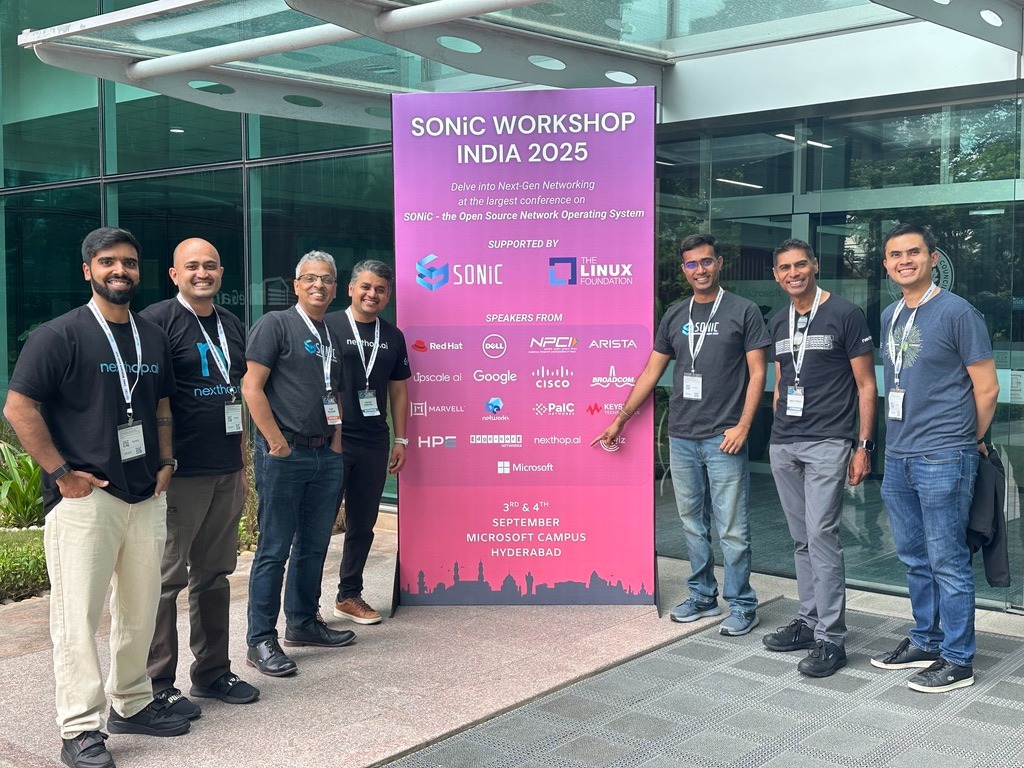
The Nexthop AI team at the SONiC India Workshop in September 2025, held at the Microsoft India Development Center (IDC) in Hyderabad. The author, Ryan, is pictured on the far right.
To recap our progress, Nexthop AI was started in 2024 by our Founder & CEO, Anshul Sadana. We have hardware and software teams that design network switches, and we write software to enable that hardware to be deployed at hyperscalers. On the software side, many of us have dedicated our careers to building software on NOSes. Our backgrounds span everything from BIOS to drivers, routing protocol stacks, configuration, telemetry, network management and test infrastructure. At Nexthop, we work on open NOSes such as SONiC as our starting point.
We continue to apply our years and decades of experience with building networks, but the structure of our software engineering is distinct from working on proprietary NOSes. We still conduct internal maintenance meetings– discussing code evolution, reviewing test pass rates, tracking bugs, and monitoring project progress– all of which have equivalents in the community. Instead of doing all of this in-house, our work requires active participation in open-source Community Workgroup Meetings and Issues Meetings, where topics impacting various participating companies are discussed every week. As a consequence, our team discussions are no longer limited to co-workers, but routinely include chip vendors, operators, and other system vendors.
We not only build infrastructure for AI, we are equally passionate about using AI technologies for coding, testing, and workflow automation. Over the past six months, our team has achieved significant progress, actively integrating the latest advancements in AI coding assistants, toolchains, and agents. Unlike many other companies and software systems that are over a decade or two in existence, we have had the opportunity to start fresh with an AI-first approach and adopt a development toolchain that is primarily AI-native. Working within the open-source community provides a distinct advantage: our AI tools can leverage both our direct contributions and the extensive context available from all open-source code on GitHub. Furthermore, our third-party systems are designed with rich connectors, allowing them to seamlessly access and utilize context across all our different internal tools.
Combining our team’s experience and expertise, with SONiC as a foundational part of our software, I’m excited about some recent milestones:
- Our first three products are now in the community SONiC repository
- We have had meaningful contributions across the NOS stack in SONiC and FBOSS
- We are among the top 10 contributors of the SONiC project over the past year and are a member of the governing board
- We are co-leading the SONiC BMC Workgroup, to support technology shifts like the use of liquid cooling
- We are able to support pioneering AI-enabling technology like 1.6Tbps and Co-packaged Optics (CPO) in the SONiC community, enabling Nexthop’s Tomahawk-6 based products.
Nexthop has had a very exciting and productive journey with open networking and we have made some significant strides to enable the next generation of AI-enabling network infrastructure. We’ve built upon our extensive NOS expertise, fully embracing both the industry’s open source movement and the most recent advancements in AI technology. Whereas other established vendors are still trying to promote the uniqueness of their proprietary OS, our approach of leaning into the industry direction of innovating with openness is setting us up for the next decade of innovation.
SONiC and the SONiC logo are registered trademarks of the Linux Foundation. See sonicfoundation.dev
