
The Hyperscaler Paradox – Build, Buy or Partner?
For the last two decades, the networking industry hasn’t changed much – most companies buy products from large OEMs and a handful of hyperscalers build on their own using an ODM model.
AI has forced everyone to rethink their engagement models. A lot has been said on the growth of AI and multiple gigawatts of capacity being added as quickly as possible. When you are spending $100B+ annually on infrastructure, you don’t have to buy an off-the-shelf product that the market has to offer. You can customize it to your own needs, without worrying about anyone else. However, speed of execution matters. The world of AI is so hypercompetitive that a 3 month delta on the availability of a next-gen cluster can shift market share significantly. The big question is how can a hyperscaler execute really fast with the existing ecosystem?
A new JDM model emerges
In most other situations, the obvious answer to build something that only one company needs would be to double down and add more resources to do it yourself. However, there’s a different priority now. If a Hyperscaler can add more resources, the number one priority is to build their own GPUs, XPUs, AI models and applications. At the same time, they need a lot of highly reliable network switches to interconnect these GPUs and turn them on as quickly as possible. Our customers are telling us that their needs are so great that no single supplier in the world is able to meet all their needs. They need more options.
But the teams at these large hyperscalers are really smart. They already know how to build complex hardware systems on their own. They already have a Network Operating System of their own. They have immense buying power and get lower costs than almost anyone else. Working with hyperscalers needs a different model – not the typical vendor-customer setup.
With Hyperscalers, you can innovate but not differentiate. Differentiation usually means some cool feature that is unique. But these companies want to be multi-sourced. If any one supplier has unique features, that creates a lock-in and violates some of the basic principles of deploying at scale. Guess what? The entire networking industry has been focused on differentiating with cool features and a lot of marketing for decades!
At the same time, the scale and pace in this ecosystem requires a lot of innovation. So how do you innovate, but not lock in the customer? Well, you partner with them. That’s the fundamental difference with what Nexthop offers compared to the leading OEMs today. We co-develop our products. We share our ideas openly (under NDA of course). We iterate on emerging ideas. Equally important – we have trust between us and our customers. We are partners on a journey to building the most efficient products for them, with them.
Building custom products is usually expensive. When you have thousands of customers, the R&D costs, supply chain management, manufacturing and sales overhead are all amortized across those customers. This is what investors like to see – leverage in your business model. Build a product once, and keep selling it to customers globally and reap benefits. The AI buildouts are so large now that a custom product for just one hyperscaler can be higher volume than the rest of the market added together!
I asked one of our customers – what did they want Nexthop to be over the next decade. Their answer was simple – “Be the perfect blend of our ODM and OEM ecosystem”
A company built for SONiC and FBOSS
Building very reliable, cutting edge switches is not easy. We rely on merchant silicon from partners such as Broadcom. The system design has room for innovation and we invest heavily there. But what about the OS? Hasn’t this been the barrier to entry for decades in this space? And in some ways the real “differentiation”?
Well, the top 7 Hyperscalers in the world no longer use any proprietary vendor OS for many of their large scale deployments. They use their own OS – often derived from open source initiatives such as SONiC® or FBOSS. But it’s still software. You have to nurture it with bug fixes and constant improvements. You also need to integrate it with every new product. Equally important – the entire stack needs to be reliable. No corner case bugs, or reboots when you change port configs or grey areas that take days to debug.
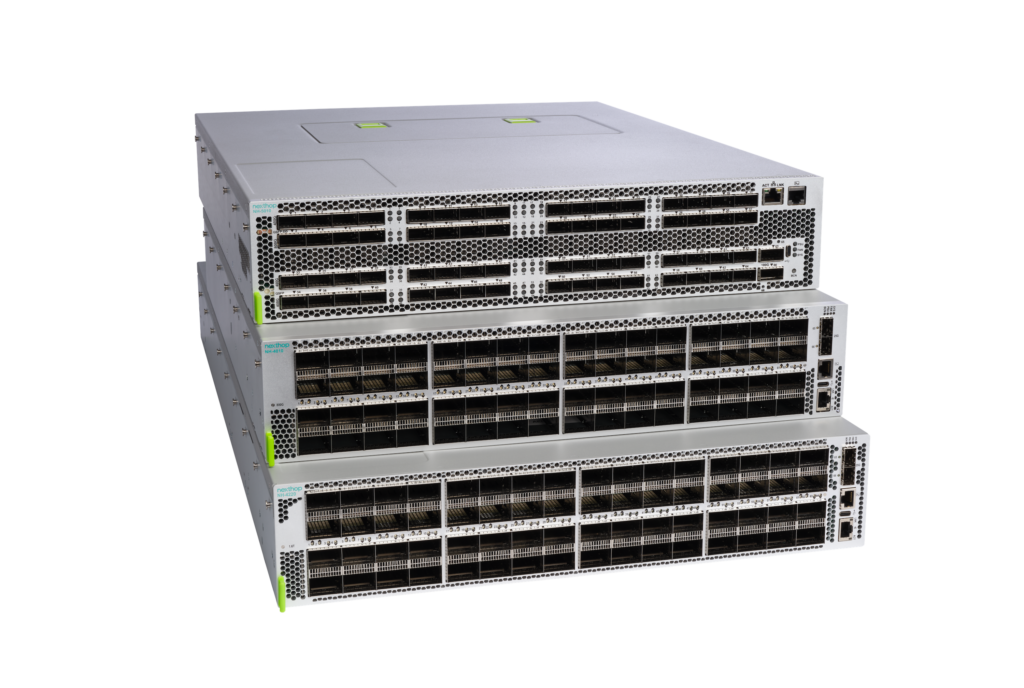
We took this to heart and built Nexthop AI to not have competing operating systems. We build just with the OS that our customers want to deploy – their OS. You hear all these counter arguments that open source is hard, it’s not stable, etc. Well, that was true in the early days. Today SONiC is already running on millions of switches in production networks at these hyperscalers. And thanks to the deep software expertise of our team, unlike pure ODMs, we develop and enhance the customer OS and ship our products fully integrated – saving 6 to 9 months of NPI cycles.
Can Neo Clouds use the same products?
While we are building great products for some of the Hyperscalers, the same products and solutions can often be used by NeoClouds for smaller AI deployments – reaping benefits of the innovations we are driving at scale. We offer a turnkey solution with hardened and fully supported Nexthop NOS, powered by SONiC, integrated with our products for the NeoClouds and services to make your deployment seamless.
Our Team and the Culture that binds us
At Nexthop, we are a very collaborative team – within the company, with our customers and with all our partners. We have some of the best talent in our industry. Individuals are empowered to make rapid decisions. This cultural shift is a requirement to truly partner with Hyperscalers. It’s easier said than done.
Most companies have a process to “pad” their schedules. They play a 3-round negotiation game with their customers, starting high and eventually agreeing to something more reasonable. They want to hide their best secrets – well they need to differentiate! That veil creates a barrier within the different functions – control of information, artificial schedules and a lot of stress!
To truly partner with your customers, you have to get rid of that veil. That’s not easy but it is this unique culture that has enabled us to truly partner with these Hyperscalers. Having a highly motivated team can make even the most complex tasks look easy.
My favorite comment I heard from one of the Hoppers on what they liked most about working here – Happy Mondays!
Looking Ahead
Large scale AI infrastructure is not a market for the faint-hearted. We are in an era of unprecedented scale and relentless change, a new frontier in infrastructure. The old vendor-customer ecosystem can’t keep up. It’s no longer about cost per gigabit but all about cost per token. At Nexthop, we’ve traded in differentiation for deep partnership, built a company for speed, and created a model for true co-innovation. We are not just a supplier; we are the extension of our customer’s engineering team, ready to build the future of AI infrastructure. The time for the new business model is now and our team is ready!
